Ett samarbete mellan Europa Direkt Malmö på Stadsbiblioteket och Ungt valdeltagande i Malmö och Skåne.
http://webapps2.malmo.se/evenemang/EventGuide/View/Ovrigt/Europeiska_sprakdagen_734273
Ett samarbete mellan Europa Direkt Malmö på Stadsbiblioteket och Ungt valdeltagande i Malmö och Skåne.
http://webapps2.malmo.se/evenemang/EventGuide/View/Ovrigt/Europeiska_sprakdagen_734273
EDUCATION. The field of Caucasus studies is growing stronger at Malmö University. A new course with case and field studies is introduced, and the university has been playing host to three visiting experts specialising in Caucasus.
The trio are made up of Georgian professors Alexandre Kukhianidze and Zaal Kikvidze who have been joined by Aytan Sadigova, a lecturer from Azerbaijan. Getting the three together is quite a feat as the courses themselves are taught completely online.
“As our courses are multi-disciplinary covering politics, culture and history it is very important for us to have strong contacts with scholars from the region. For area studies and to establish connections for field work then it is vital,” says Karina Vamling, Professor of Caucasus Studies, at the Faculty of Culture and Society at Malmö University.
Read the whole story:
http://www.mah.se/english/News/News-2014/Meeting-of-minds-as-Caucasus-academics-gather-in-Malmo/

Alexandre Kukhianidze is professor in political science of Tbilisi State University, Georgia. His visit to Malmö University and Caucasus Studies at the Faculty of Culture and Society is funded by a Linneaus-Palme grant.
Professor Kukhianidze has been a frequest visitor to Caucasus Studies in Malmö and this time he stays for three weeks (September 1–23).
During his visit he has given the web/campus seminar: Georgia after the Soviet collapse. What is Georgia today?
New publication in Slavic Review. Interdisciplinary Quarterly of Russian, Eurasian, and East European Studies. (73, 2)
Katrine Bendtsen Gotfredsen: Void Pasts and Marginal Presents: On Nostalgia and Obsolete Futures in the Republic of Georgia
Abstract
In contemporary Georgia and beyond, nostalgia for the Soviet past is often ridiculed and dismissed as a reactionary wish to turn back time. In this article, however, I explore generational nostalgia as temporal displacement of present political struggles. Drawing on life story interviews with middle-aged and elderly people in the provincial town of Gori, I argue that nostalgic longings may be understood as active attempts to presence personal pasts and futures that have publicly been rendered absent by an official rhetoric and practice that explicitly rejects the Soviet past. From this perspective, post-Soviet generational nostalgia temporally connects several dimensions of absence: the experience of one’s personal past being publicly cast as void; a perceived lack of social security, influence, and significance in the present; and a dynamic whereby these two dimensions render former dreams and visions for the future obsolete.
http://www.slavicreview.illinois.edu/current/abstracts732/index.html#gotfredsen
Tamuna Lomadze is exchange PhD candidate within the Erasmus Mundus Eminence program. Her area of studies is sociolinguistics and the topic of her thesis is “Cognitive Aspects of Communicative Influence on Public Opinion”.
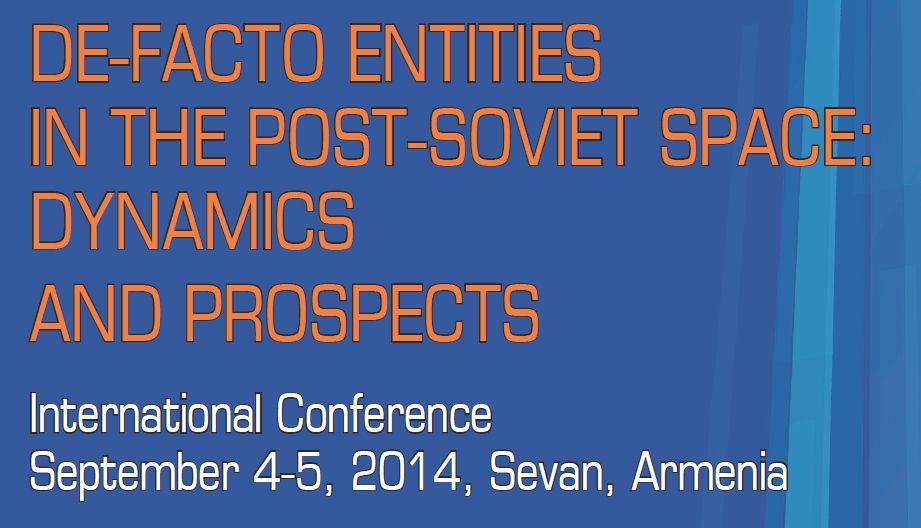
Tamuna is visiting Malmö University for 18 months during the academic years 2014/2015 and 2015/2016. Her home institution is the Department of Kartvelology and Sociolinguistics, School of Humanities of Saint Andrews Georgian University, Tbilisi, Georgia (link).
Maka Tetradze is exchange PhD candidate within the Erasmus Mundus program. She is visiting Malmö University and Caucasus Studies for the two academic years 2013/2014 and 2014/2015. She is working on a dissertation on the Lezgian language (Dagestan, Northest Caucasian languages).
Her home institution is Tbilisi State University and the Chikobava Institute of Linguistics.
Meeting at Malmö University for Caucasus Studies students and exchange students from Georgia, Armenia and Azerbaijan. Head of department Teresa Tomasevic opens the meeting,
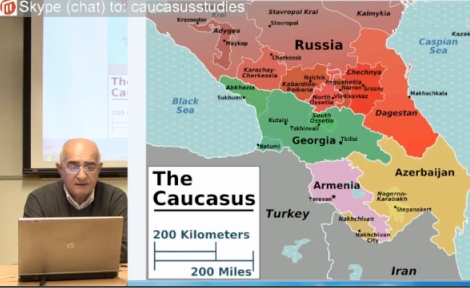
Welcome to a web and campus seminar with Visiting professor Alexandre Kukhianidze, Professor of Political Science at Tbilisi State University, followed by discussion on Skype and in the studio:
Georgia after the Soviet collapse. What is Georgia today?
Participation: Online or campus.
When? September 10, 16.30–ca 18.00.
Where? Online (www.mah.se/imer/caucasusstudies) or Malmö University campus studio at Kranen
Open to staff and students
Senior lecturer Märta-Lisa Magnusson participates in the conference “De-facto Entities in the Post-Soviet Space: Dynamics and Prospects” (September 4-5, 2014) as an invited speaker. The title of her paper is De-facto States in the Context of the Current International Law and International Politics.
The conference is organized by Academic Swiss Caucasus Net, University of Fribourg, Switzerland) and Caucasus Institute, Yerevan, Armenia).
In the first number of Nordisk Østforum (2014) Bjørn Harvig’s book “Kaukasus og Kildevand. Historier fr en rejse til fods” (The Caucasus and Spring water. Stories from a journey by foot) is reviewed by Karina Vamling (pp. 83-85).
Available online at the Journal’s website, link.