New publication on Soviet Caucasus: We witnessed the Soviet break-up

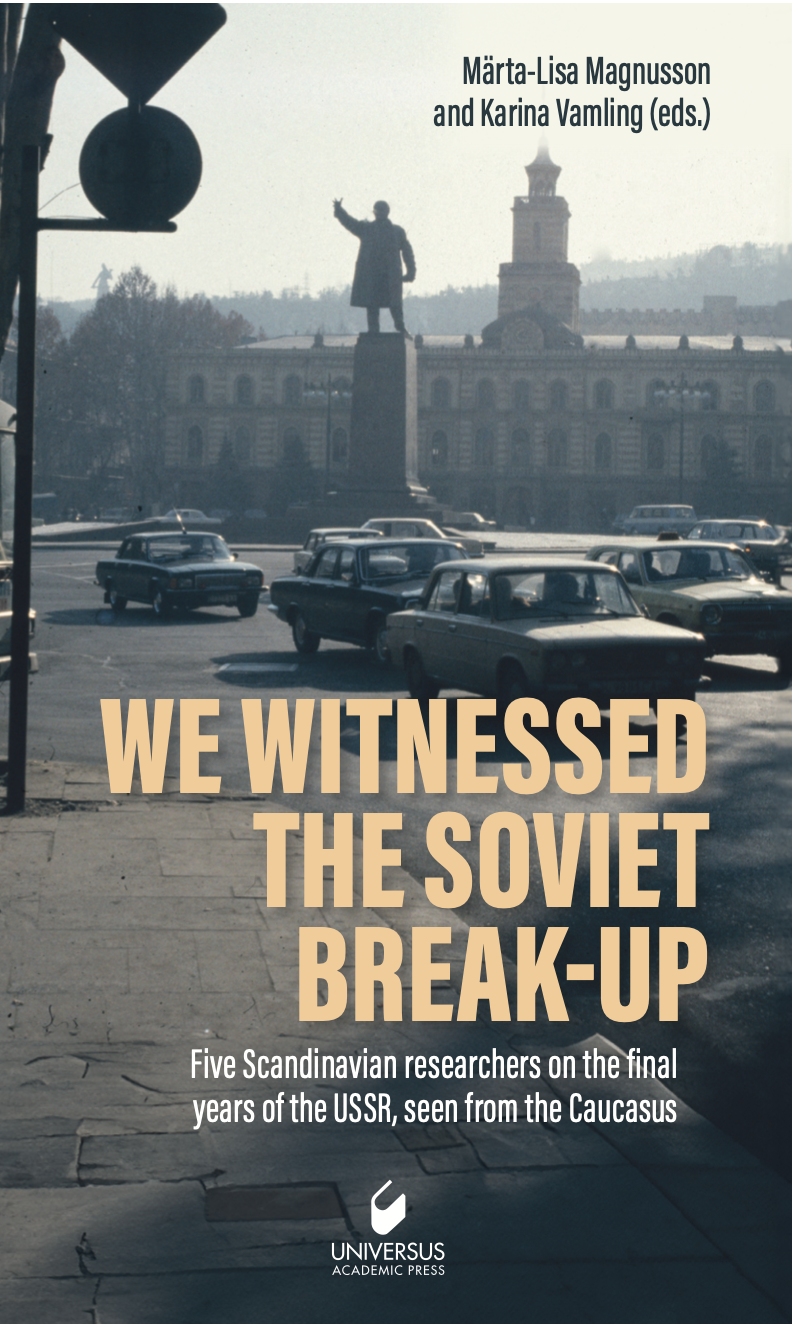
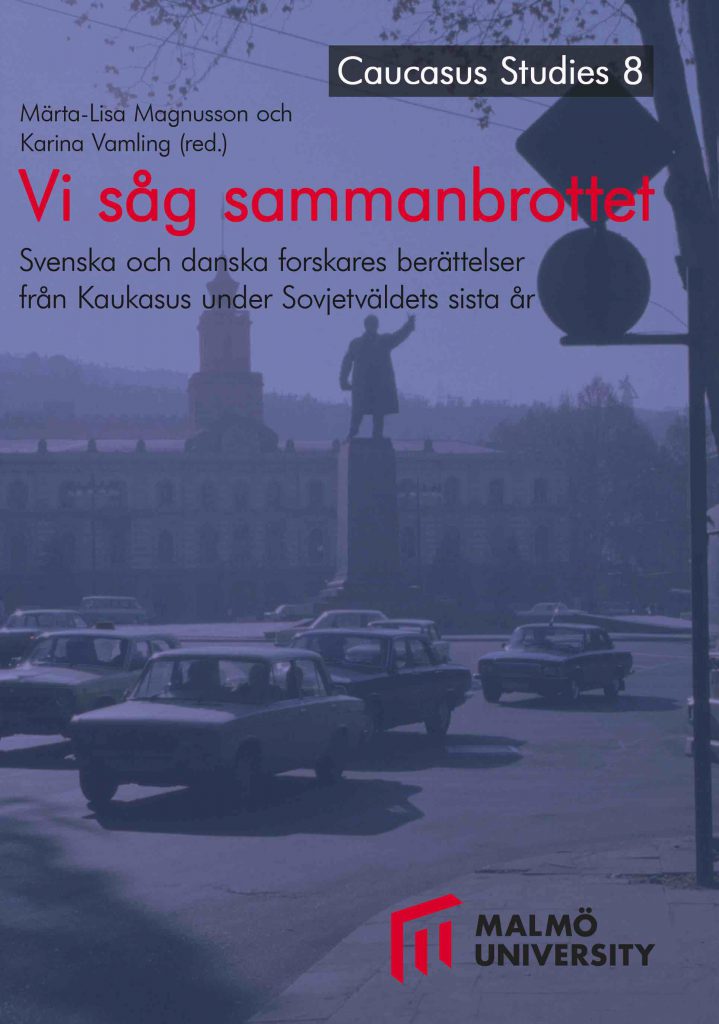
A new publication is out, edited by Märta-Lisa Magnusson and Karina Vamling. Publisher Universus Academic Press, Lund (Sweden), 2026. Publisher’s webpage: https://universus.se/arkiv/book/we-witnessed-the-soviet-break-up. With numerous illustrations from the authors’ visits to the Caucasus in the late 1980s and early 1990s.

Book presentation February 19

Abstract

The authors recount their experiences of conducting fieldwork and traveling as researchers in the Caucasus region in the final years of the Soviet Union. This period, from the late 1980s to the early 1990s, is crucial for the understanding of current developments not only in the Caucasus but in all countries that were once part of the Soviet Union. They report on political processes in the Caucasus, including the emergence of new movements for independence, increasing tensions with Moscow, the breakdown of Soviet structures at different levels, and the growing importance of national cultures. They describe how premodern traditions still play a role, despite Soviet modernization, account for specific cultural features and similarities, and witness deepening ethnic antagonism. The authors are political scientist Ib Faurby, cultural geographer Lars Funch Hansen, slavicist Märta-Lisa Magnusson, historian and Iranologist Søren Theisen, and linguist and Caucasologist Karina Vamling.

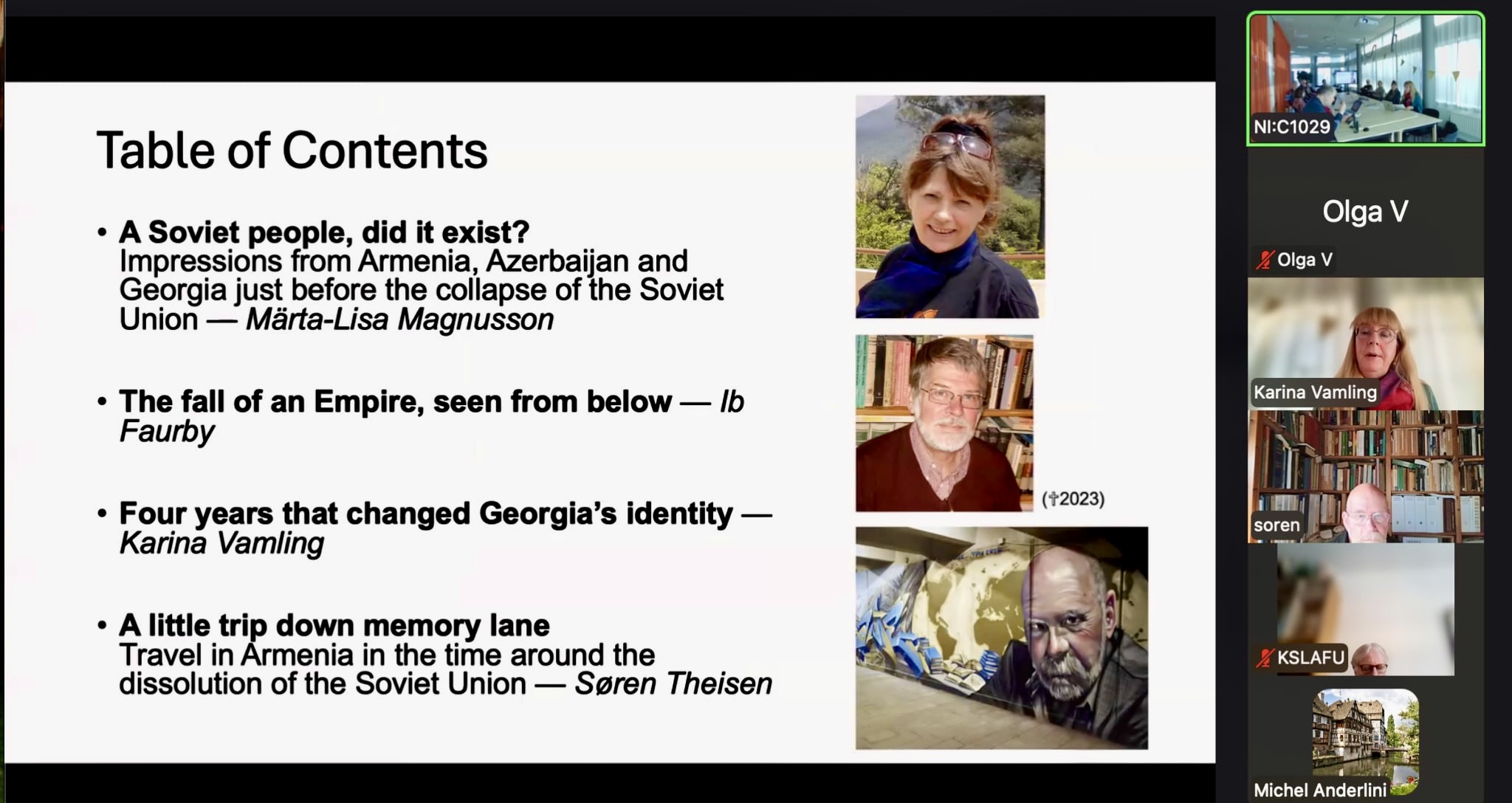
Table of Contents

  1. Introduction, 9
  2. A Soviet people, did it exist? Impressions from Armenia, Azerbaijan and Georgia just before the collapse of the Soviet Union, Märta-Lisa Magnusson, 14
  3. The fall of an Empire, Ib Faurby, 44
  4. Four years that changed Georgia’s identity, Karina Vamling, 65
  5. A little trip down memory lane. Travel in Armenia in the time of the dissolution of the Soviet Union, Søren Theisen, 91
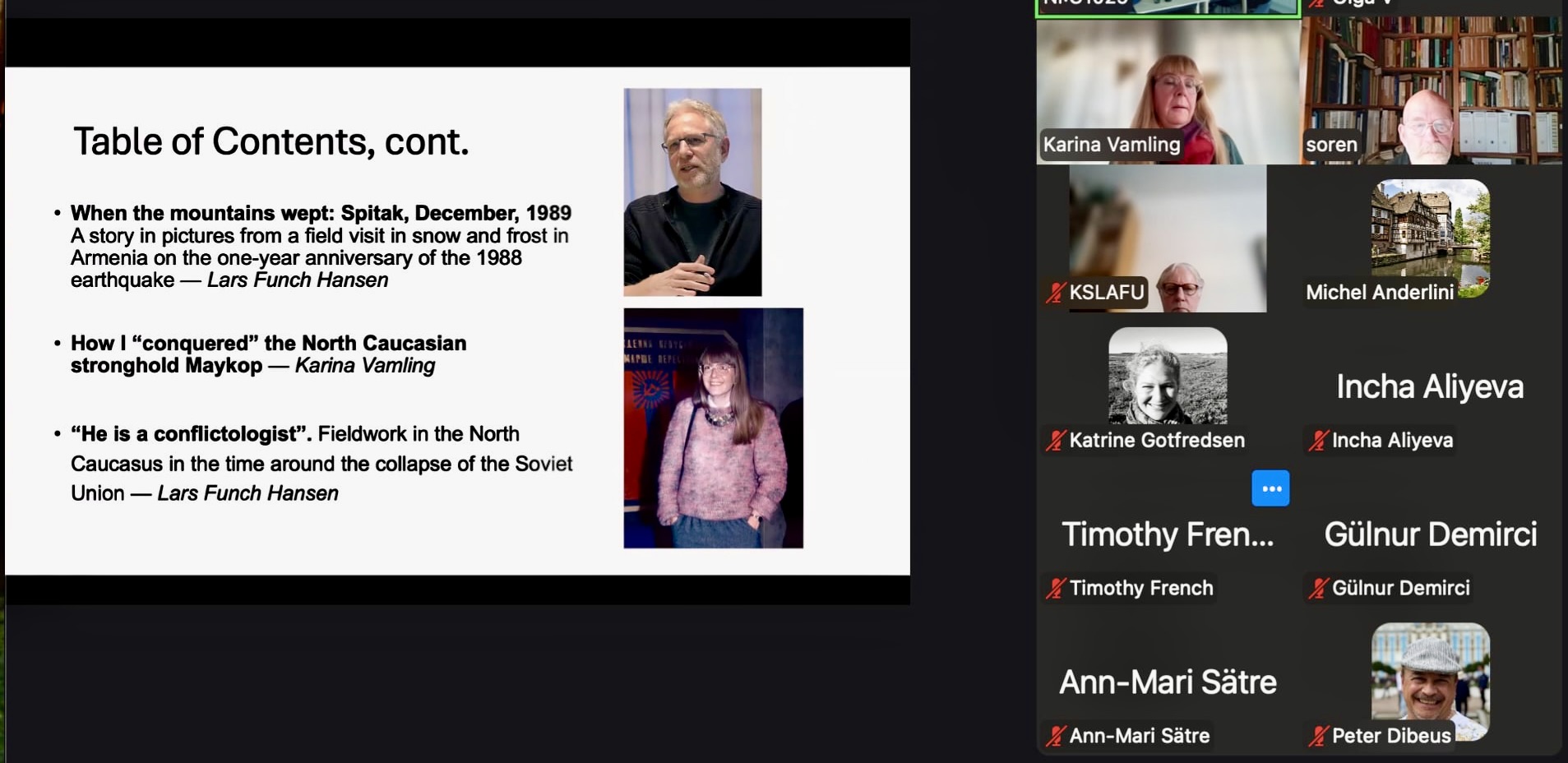
  6. When the mountains wept. Spitak, December 1989. A story in pictures from a visit in snow and frost in Armenia on the one-year anniversary of the earthquake 1988, Lars Funch Hansen, 105
  7. How I “conquered” the North Caucasian stronghold Maykop, Karina Vamling, 113
  8. “He’s a conflictologist” Fieldwork in the North Caucasus in the time around the collapse of the Soviet Union, Lars Funch Hansen, 127
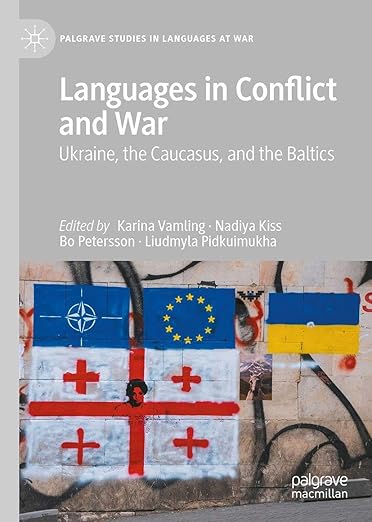
New anthology – Languages in Conflict and War

New publication is out: “Languages in Conflict and War. Ukraine, the Caucasus, and the Baltics”, available as ebook. https://link.springer.com/book/10.1007/978-3-032-08419-4…

Both North and South Caucasus are featured in this new publication — Georgia in the South and the Circassians in the North: Adyghea, Kabardino-Balkaria and Kuban with Shapsugia.

– Book series: Palgrave Studies of Languages at War.
– Table of contents and contributors: https://link.springer.com/book/10.1007/978-3-032-08419-4#toc
– Editorial team: Karina Vamling, Nadiya Kiss, Bo Petersson, Liudmyla Pidkuimukha.

Book release video: We witnessed the break-up of the USSR

Release of the book “We witnessed the break-up”, where a group of Swedish and Danish researchers recount their experiences in the Caucasus region during the final years of the Soviet Union. Find the book here : http://urn.kb.se/resolve?urn=urn:nbn:se:mau:diva-49064 (download or print). Published in the series Caucasus Studies at Malmö University, 2021.

The Caucasus, like the Baltic region, was on the outskirts of the Soviet Union, but these two regions were to play an important role in the reform process that Gorbachev initiated in 1985 and that six years later led to the disintegration of the Soviet Union.

In their contributions the authors write about the new movements for independence in the Caucasus and increasing tensions with Moscow, how the Soviet structures at different levels were breaking down and the national cultures became increasingly important. They describe how premodern traditions still play a role, despite Soviet modernization, account for specific cultural features and similarities and also witness deepening ethnic antagonism.

The authors are political scientist Ib Faurby, cultural geographer Lars Funch Hansen, researcher on minority issues Helen Krag, slavicist Märta-Lisa Magnusson, historian and Iranologist Søren Theisen and general linguist Karina Vamling.

Editors of the book are Märta-Lisa Magnusson and Karina Vamling.

Welcome to book release – Dec 8

“Vi såg sammanbrottet” – Svenska och danska forskares berättelser från Kaukasus under Sovjetväldets sista år

“We witnessed the break-up.” – Six Swedish and Danish researchers on the final years of the USSR seen from the Caucasus, edited by Märta-Lisa Magnusson and Karina Vamling (In Swedish and Danish).

When: December 8, 10.15–11.00. Where: Zoom https://mau-se.zoom.us/j/66199315527?pwd=MXNpemgwVEgxMTVmNVJZTi84TkJOQT09

On Christmas Day 1991 Mikhail Gorbachev resigned as President of the Soviet Union. The country that he had been the leader of, as General Secretary of the Communist party since 1985 and as President since 1990, had ceased to exist. The crucial event that led up to the final collapse was the meeting in Minsk on December 8 1991, when the leaders of the Russian Federation, Belarus and Ukraine decided to establish an  interstate organization, CIS, the Commonwealth of Independent States.

In the anthology “We witnessed the break-up” a group of Swedish and Danish researchers recount their experiences in the Caucasus region during the final years of the Soviet Union and the period shortly after. The authors are political scientist Ib Faurby, cultural geographer Lars Funch Hansen, researcher on minority issues Helen Krag, slavicist Märta-Lisa Magnusson, historian and Iranologist Søren Theisen and general linguist Karina Vamling.

The Caucasus, like the Baltic region, was on the outskirts of the Soviet Union, but these two regions were to play an important role in the reform process that Gorbachev initiated in 1985 and that six years later led to the disintegration of the Soviet Union.

In their contributions the authors write about the new movements for independence in the Caucasus and increasing tensions with Moscow, how the Soviet structures at different levels were breaking down and the national cultures became increasingly important. They describe how premodern traditions still play a role, despite Soviet modernization, account for specific cultural features and similarities and also witness deepening ethnic antagonism.

The book is published by Malmö University in the series Caucasus Studies and is available as an ebook (download link) and will shortly appear as print-on-demand.

Roundtable on Georgian and Swedish literature, Oct 22

Join us for a Roundtable: Georgian literature in Sweden – Swedish literature in GeorgiaPoetry and children’s literature are in focus, as well as challenges in translating culture specific features. Participants are Kristian Carlsson, publisher, writer and translator; Tamara Tchikovani, translator, Manana Kock Kobaidze, lecturer, translator and writer and Hanna Sandborgh, PhD Candidate at Tbilisi State University with a special interest in translation theory.
October 22, 3.15-5.00 pm (Sign-up here) (in Swedish).
The event is part of series of seminars and events “Meet Georgian Culture at Malmö University” (program). This year the Georgian capital Tbilisi has been appointed “World book capital“.

Kristian Carlsson is a Swedish writer and translator. His publishing house Smockadoll has contributed to the translation of a number of Georgian books into Swedish. His poetry is also translated into Georgian.

Tamara Tchikovani, born in Georgia, moved to Sweden in 1992 and has translated several books by Astrid Lindgren into Georgian: Ronja Rövardotter (Diogene 2002, Bakur Sulakauri Publishing 2019); Bröderna Lejonhjärta (Diogene 2005, Bakur Sulakauri Pablishong 2020) och Lotta på Bråkmakargatan (Bakur Sulakauri Publishing, 2012) 

Manana Kobaidze was born in Georgia and moved to Sweden in 1996. She is a lecturer in Georgian at Malmö University, and also a writer and translator. Her recent collection of poetry is Akhali agvisto (Den nya augusti) gavs ut i Tbilisi 2018. She has translated poetry from Swedish into Georgian (bl.a. Tomas Tranströmmer 2012, Karin Boye 2013) and Georgian into Swedish (Lia Liqokeli 2015, Den Kaukasiska fallenheten, 2018 (28 Georgian poets).

Language and Society in the Caucasus

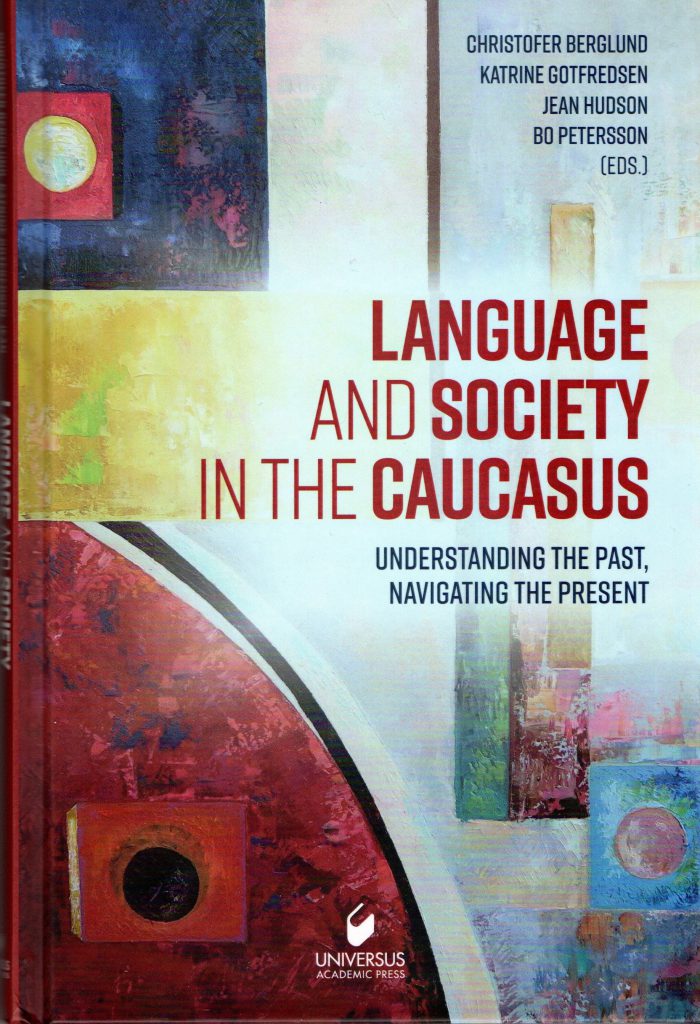
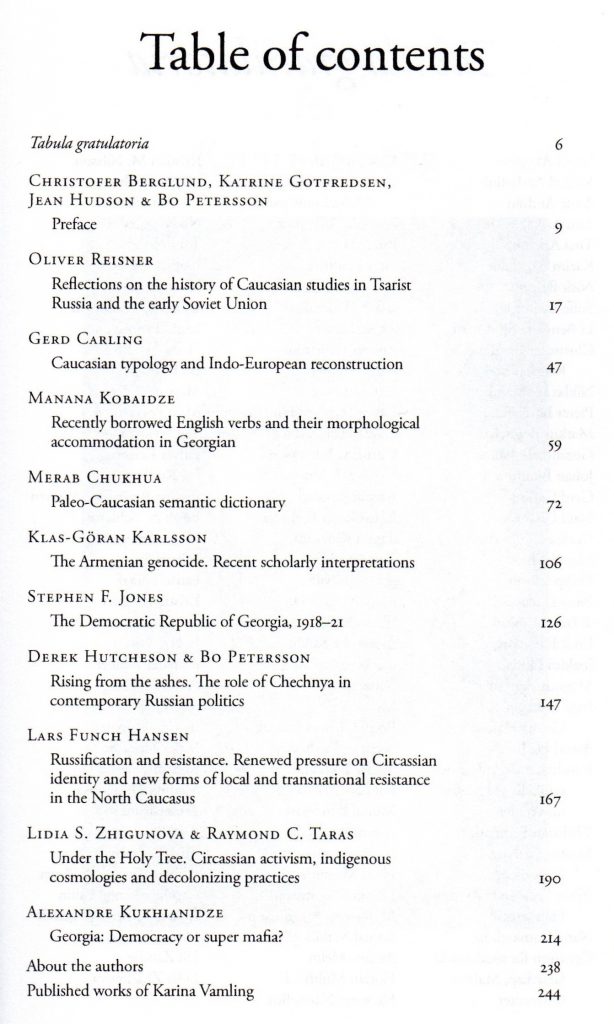
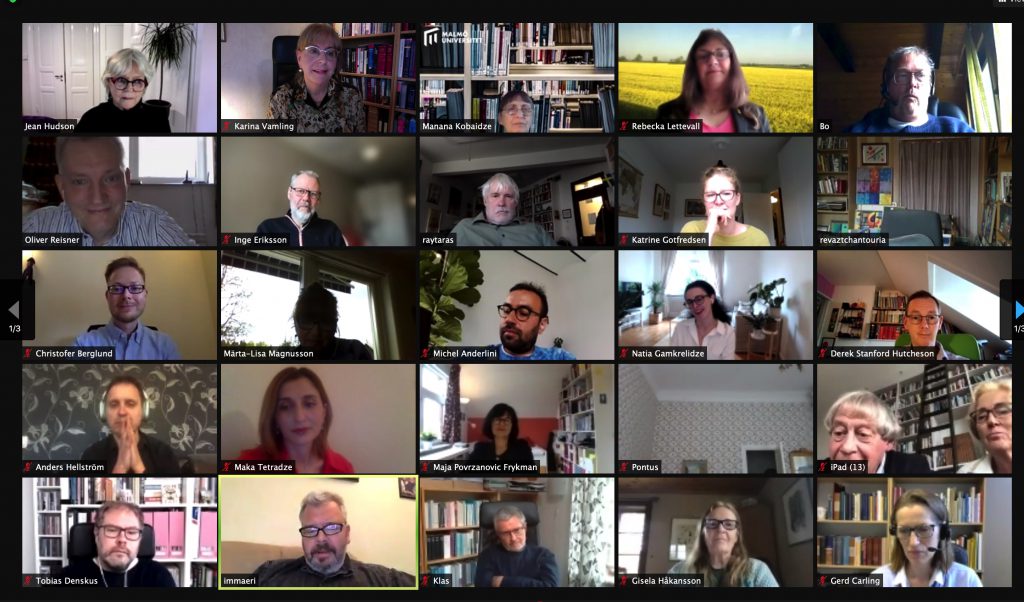
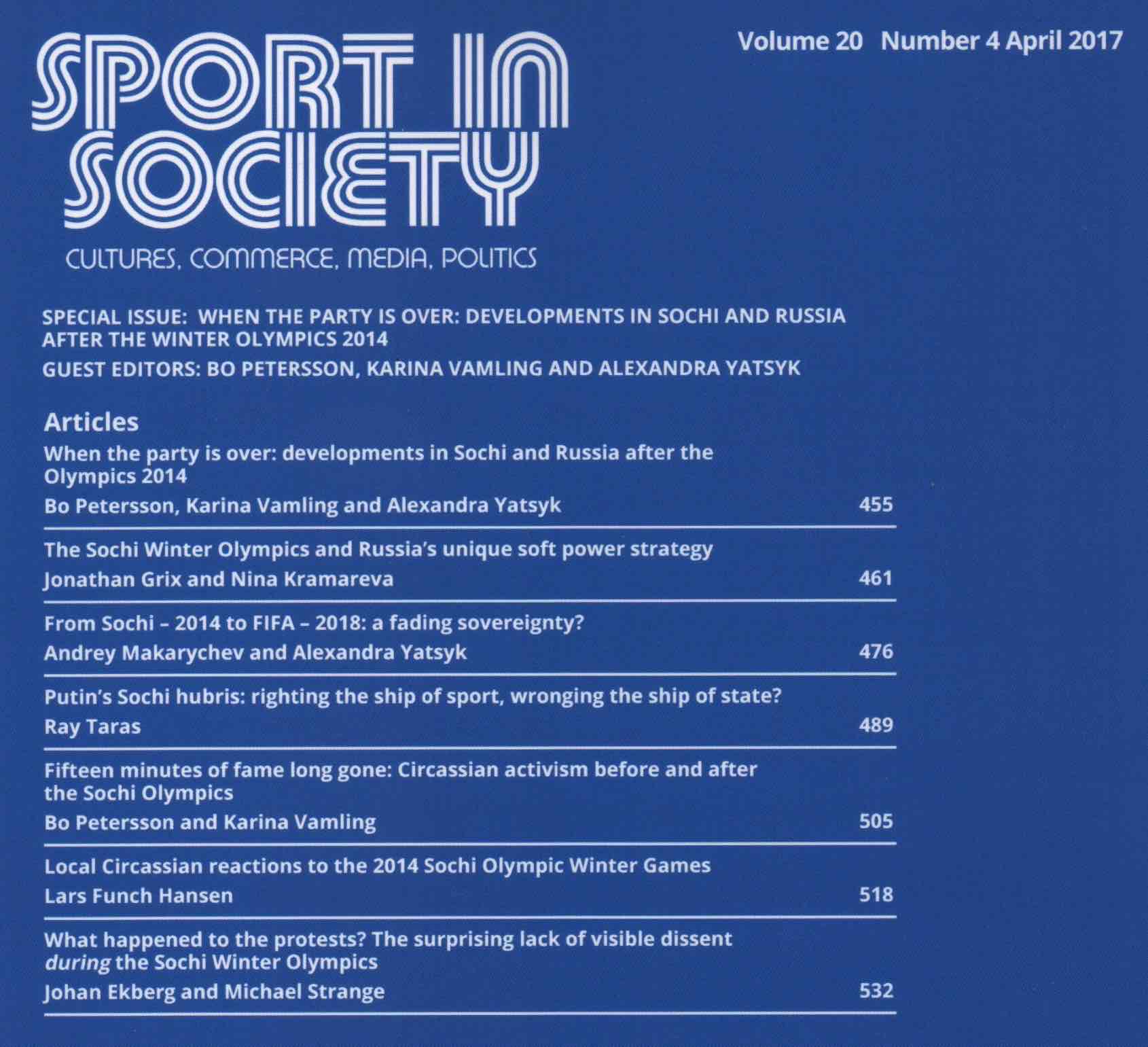
New publication: Language and Society in the Caucasus. Understanding the past, navigating the present – a collection of articles presented as a festschrift for Prof. Karina Vamling at a zoom seminar, May 25 (below). Editors of the volume are Christofer Berglund, Katrine Gotfredsen, Jean Hudson and Bo Petersson. Read the book

Caucasus Studies at Frankfurt Book Fair

New publication – Basque–Georgian-Russian Dictionary

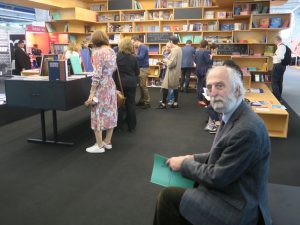
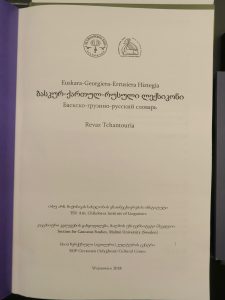
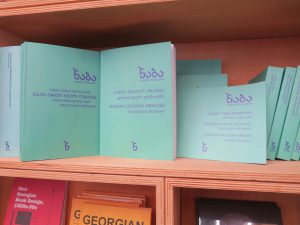
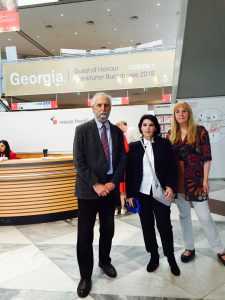
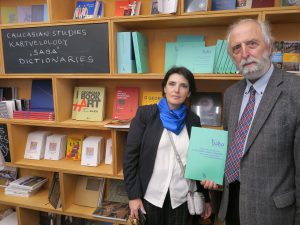
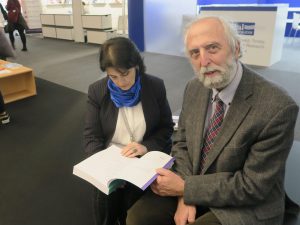
Congratulations to Dr. Revaz Tchantouria, Caucasus Studies at Malmö University, who has published a Basque–Georgian-Russian Dictionary. The book was on display at the Frankfurt Book Fair October 11-14, 2018, in a series of dictionaries published by Saba Publishers, Tbilisi. The Basque-Georgian-Russian Dictionary is edited by Prof. Merab Chukhua and has been published with kind support from Prof Marina Beridze. At the 2018 Frankfurt Book Fair, Georgia was the “Guest of Honour”, and  books from Georgia were widely exhibited at the Fair.

Apart from the trilingual dictionary, the Basque–Georgian-Russian Dictionary includes a grammar sketch of Basque and a Georgian index.


New publications by Erasmus Mundus PhD Candidates

 Agil Valiyev (Odlar Yurdu University, Baku) and Elnur Aliyev (Tbilisi State University), both Erasmus Mundus PhD candidates at the Section for Caucasus Studies in Malmö, have recently published conference papers.  Congratulations!

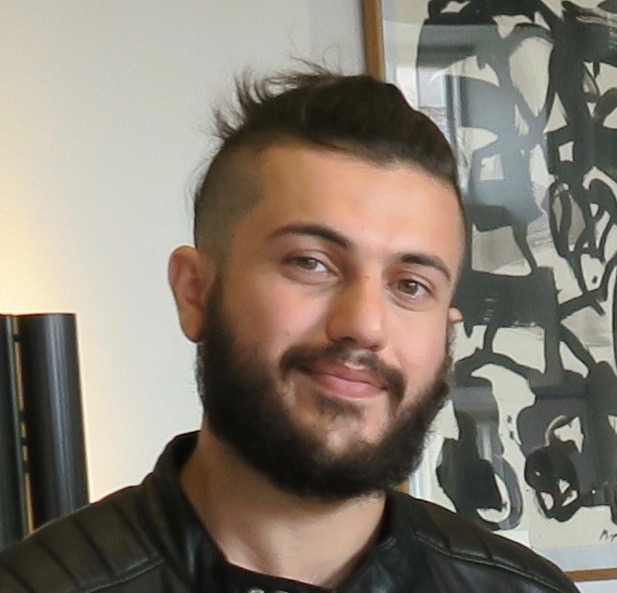
Elnur  Aliyev (left) published a conference paper on the North Caucasian Dagestan language Budukh: “Genetic Map of the Budukh Nation”, in the section “Regional Cultures and its Researchers” at the VI International Scientific Conference, January 25-26, Prague, pp. 38-47.

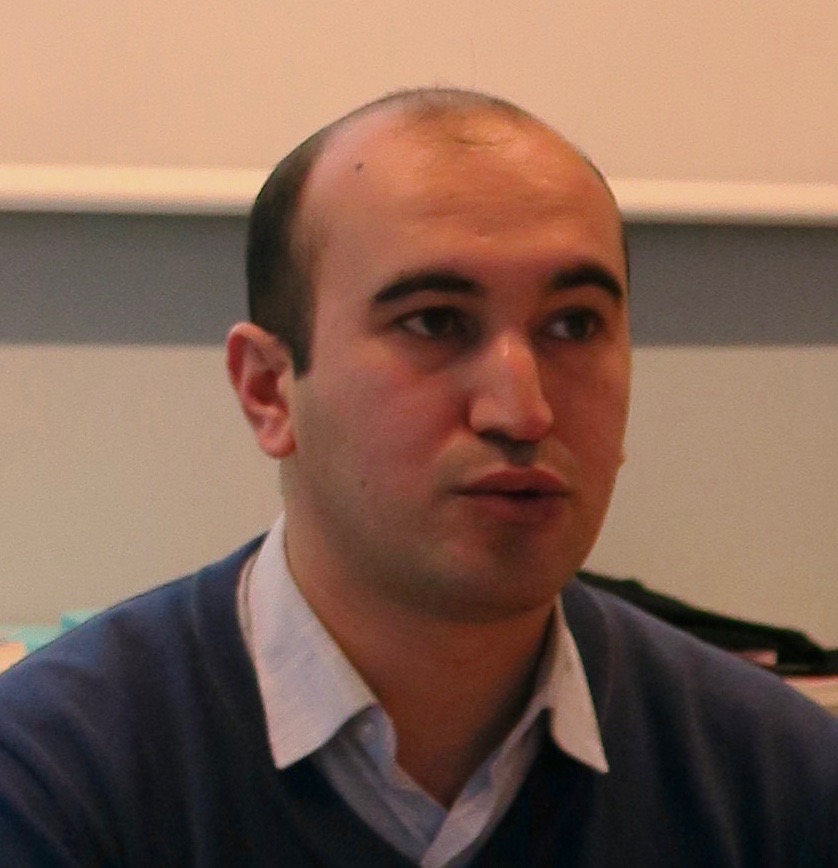
The title of Agil Valiyev‘s (right) publication is “The understanding of cultural diplomacy, its history and Azerbaijan model” at the same conference but in the section “Informatization and Features of the Development of Dialogue between Cultures”, pp. 58-66.


New publication: Endangered Languages of the Caucasus and Beyond

Recently published: Endangered Languages of the Caucasus and Beyond, edited by Ramazan Korkmaz and Gürkan Doğan. Brill Publishing , 2016.

The volume is based on the 2014 International CUA Conference on Endangered Languages, organized by the Caucasus University Association (CUA) at Ardahan University, Turkrey. Prof. Karina Vamling, Malmö University, contributes with an article on Megrelian.
Read more about the publication:
http://booksandjournals.brillonline.com/…/9789004328693;jse…